The way people choose spaces has fundamentally changed. Before an international traveler books a boutique hotel, or before an overseas investor makes an offer on a residential property, they scroll.
In fact, industry data shows that over 72% of consumers now expect an interactive digital walkthrough before making a high-ticket booking or purchasing decision. Yet, despite this demand, most businesses investing in traditional virtual reality (VR) tours see disappointing completion rates and minimal impact on their bottom line.
The problem isn't the concept of virtual exploration. The problem is traditional VR technology.
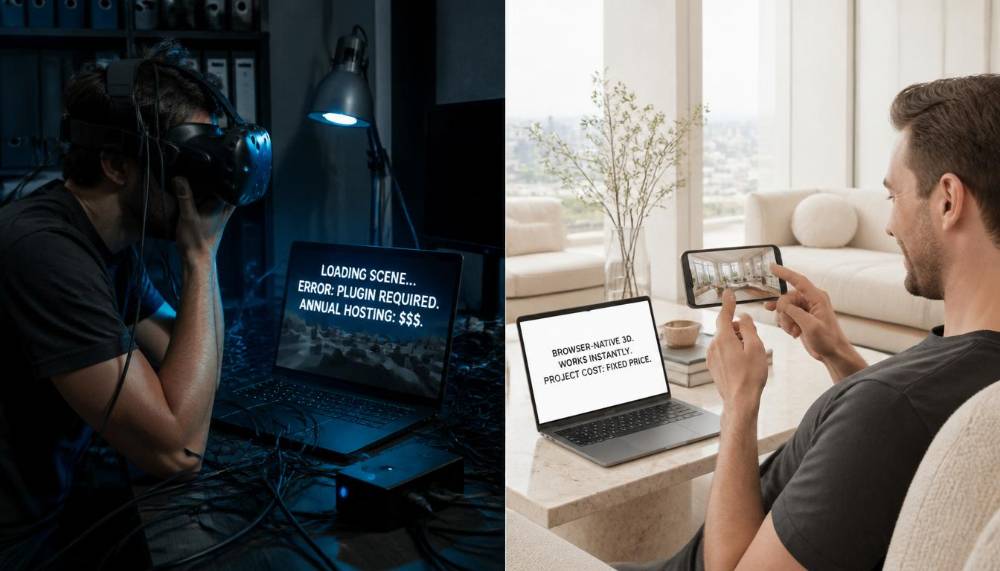
For years, legacy 3D tour software was built by engineers for technical spec sheets. It required expensive headsets, mandatory app downloads, and heavy software that buffered endlessly on mobile devices. At Berl View, we rebuilt the interactive walkthrough from the ground up—focusing on user psychology, mobile speed, and direct conversions.
Here is why traditional VR tours are failing modern spaces, and what actually works today.
1. The Friction Trap: Why Headsets and App Downloads Kill Conversions
If a potential guest or homebuyer lands on your website and has to install a third-party app, download a browser plugin, or wait 30 seconds for a bulky 3D model to load, you have already lost them.
In digital marketing, every added step in the user journey slashes conversion rates. Currently, nearly 67% of all property and travel discovery happens on mobile devices. When a legacy VR tour forces a user out of their native browser to load an external application, bounce rates skyrocket.
- The Traditional VR Flaw: Built for desktop computers and VR headsets. Mobile experiences are often an afterthought—plagued by freezing, awkward navigation arrows, and massive data usage.
- The Browser-Native Solution: Immersive walkthroughs must be 100% browser-native. A user should be able to tap a link on a five-year-old smartphone and instantly step inside your lobby or showroom with zero downloads, zero headsets, and zero friction.
2. Emotion vs. Architecture: The Problem with Clinical Renders
People do not book a hotel room or buy a home solely based on square footage. They make the decision because they can already picture themselves waking up to the morning sun in the master bedroom, or hosting friends in a warm, ambient restaurant courtyard.
Traditional virtual tours treat spaces like geometrical wireframes. They use harsh, clinical lighting and fish-eye lens distortions that make even a luxury property feel like a sterile hospital corridor.
"We built our platform because we’d seen too many great spaces go unnoticed—not because they weren't worth visiting, but because no photograph or clinical 3D render could do them justice." — The Berl View Founding Team
To drive real conversions, a digital twin must capture atmosphere. By applying custom lighting models and an aesthetic layer that favors warm tones and natural textures, you shift the user's mindset from logical evaluation to emotional connection. When someone can truly feel the space, the decision to visit in person is already made.
3. Owning Your Digital Real Estate: Bypassing the OTA Trap
One of the biggest hidden costs of legacy virtual tours is where the traffic ends up. Most traditional tour providers host your walkthrough on their own public servers, complete with prominent third-party branding and external links.
For hotels and resorts, sending traffic away from your proprietary domain often pushes guests right back into the hands of Online Travel Agencies (OTAs) like Booking.com or Expedia—costing you 15% to 25% in commission fees per reservation.
Modern 3D walkthroughs are engineered to live directly on your existing website using a single line of embeddable HTML. By keeping the experience hosted within your own UI:
- You dramatically increase page dwell time (a major positive signal for Google SEO rankings).
- You keep the user inside your direct-booking loop, allowing them to go from exploring a suite to clicking "Book Now" without ever leaving your domain.
4. Breaking Free from the Subscription Trap
The software-as-a-service (SaaS) industry has conditioned business owners to accept recurring monthly fees for everything. Traditional 3D tour platforms typically charge an initial capture fee, followed by mandatory monthly "cloud hosting" subscriptions. If you stop paying the monthly ransom, your tours are deleted or taken offline.
Your marketing assets should belong to you. The modern approach relies on a fixed-price, project-based model. From the initial briefing call to the single-day on-site capture and final rendering, the cost is clear from day one. You receive the live, shareable link and embed code with zero ongoing software bloat and zero surprise subscription hikes.
How They Stack Up
| Feature | Traditional VR Tours |
check_circle
Berl View Walkthroughs
|
|---|---|---|
| Accessibility | Requires apps, headsets, or high-end PCs | 100% Browser-Native across all devices |
| Visual Vibe | Cold, sterile, and geometrically rigid | Warm, ambient aesthetic featuring natural light |
| Mobile Speed | Heavy file sizes with frequent buffering | Instant loading with fluid, natural movement |
| Site Integration | Third-party branding that redirects traffic | 1-line HTML embed living on your own domain |
| Cost Structure | Setup fee + mandatory monthly subscriptions | Fixed-price project with zero recurring fees |
| Business Impact | Acts as a passive digital floor plan | Drives direct bookings and qualified leads |
Bring Your Space to Life
The first business in a neighborhood or category to offer a seamless, immersive experience automatically sets the standard that competitors are measured against. Whether you are marketing a residential development, a suburban restaurant, or a luxury guesthouse, your digital front door matters just as much as your physical one.
Ready to let your customers step inside? Book a 30-minute briefing call with our team and go from first scan to a live, shareable experience in under seven days.